Table of Contents
Product overview
 Updated
by Raquel
Updated
by Raquel
It's time to show you what Turn.io looks like. Hope you're as excited as we are!
Turn.io makes it easy for your social-impact organisation to have personal, guided conversations with the people you serve — at scale, on the channel they already use every day. To bring it to life, we'll follow a fictional telehealth service as we walk through the platform, so you can see how each section fits together. Picture a patient who messages "I've had a fever for three days," gets triaged automatically, receives a voice reply in their own language, and finishes with a face-to-face video consult — all without ever leaving WhatsApp. That's the kind of journey Turn.io is built to deliver.
Once you've completed all the onboarding steps, you'll receive access to your Turn.io account.
Log in to your account
Visit whatsapp.turn.io. Alternatively, you can use the login button on our Turn.io website.
Everything lives in the navigation panel on the left. Let's take the tour:
Inbox
The inbox is where you can see all conversations and provide human support, if you're planning on that.
- on the left, you can browse your conversation collections. There, you'll find via pre-built collections like Unassigned or With bot, view what your teammates are working on or create custom collections
- to the right, you have all the conversations inside that collections. You can filter and sort them, and even perform bulk actions on them
- in the middle, you have the most important part: the conversation. This is where most of the action happens, where you can reply, assign conversations, use pre-created content, get AI suggested replies, collaborate with your teammates, and much more
- finally, on the right, you can see the profile of the person you're chatting with, so that you can provide extremely personalised support. You can customise people's profiles via custom fields.
In our telehealth service, this is where a nurse picks up a patient, assigns the conversation to herself, loops in a colleague with a mention, and uses an AI-suggested reply to respond faster.
The Inbox scales from a one-person team to a large, high-volume team. By default, our system evenly distributes conversations to people who have set themselves as online, helping you manage the load. You can disable this in the settings.
Voice and Video Calling
Sometimes a message isn't enough, and you need to actually talk to someone. Turn.io lets you bring voice and video calls right into the WhatsApp conversation your patient is already in.
This is where telehealth really comes together. Video Calling on Turn.io means a clinician can start a face-to-face call directly from a WhatsApp conversation. Think of a nurse completing a visual assessment right after a triage Journey, a doctor running a follow-up consultation without asking the patient to travel, or a community health worker connecting a patient to a specialist remotely — all without leaving WhatsApp.
During the call you can take notes, and afterward you get the full transcript — the same features available on regular voice calls. And soon, AI-generated call summaries will be available too, so clinicians can focus on the patient instead of how-tos.
Calling messages
Meta requires businesses to request permission before calling, so you need to create a specific template for that.
- Request permissions to call your users — You can send the template directly to the patient on the Inbox or also build a Journey where the permission is already in place when you need it. You can branch the Journey based on how the user responds, to gracefully handle a rejection.
How to set up: go to Settings → Calls, enable calls, then switch on Enable video calls. That's it. Really!
Content
This is where you can add and edit all the delightful template messages that your users will receive through your WhatsApp chat service.
At the top, you’ll find the Templates tab, where you can add and submit message templates. These templates are notifications that can be sent to users more than 24 hours after their last message to you.
Content and stickers are also available for your operators. This is where you can save the common replies to queries in conversations (used only into your Inbox section).
Additionally, you can create WhatsApp Flows on this page. A WhatsApp Flow allows for a more structured interaction in your messaging, similar to a form within WhatsApp. Since they are created using a coding language called Flow JSON, there’s a playground where you can copy the code and paste it here.
Journeys
Journeys are a set of features that make it easier to build more complex, personalised automated chat services in Turn.io.
A Journey is typically created using multiple cards, each one adding a step, a content topic, or a feature — for example: Menu, Onboarding, Topic 1, Topic 2, and Survey. In our telehealth service, a Journey might welcome a patient, collect their symptoms, classify how urgent the case is, and route them to the right person.
There is also a multi-language feature that allows you to create WhatsApp journeys that serve customers in their preferred language. You can translate messages, templates, and triggers while automatically detecting and serving content based on user language preferences.
Building these used to mean a lot of clicking and dragging. Not anymore — which brings us to the AI features that now sit at the heart of Turn.io.
Read more about Journeys
Ripple — your AI Journeys co-pilot
Ripple is your AI Journeys co-pilot. Instead of building a Journey by hand, you describe what you want and Ripple builds it. Ask it to "create a triage journey that asks for symptoms, classifies urgency, and routes to the right agent," and it assembles the whole flow for you.
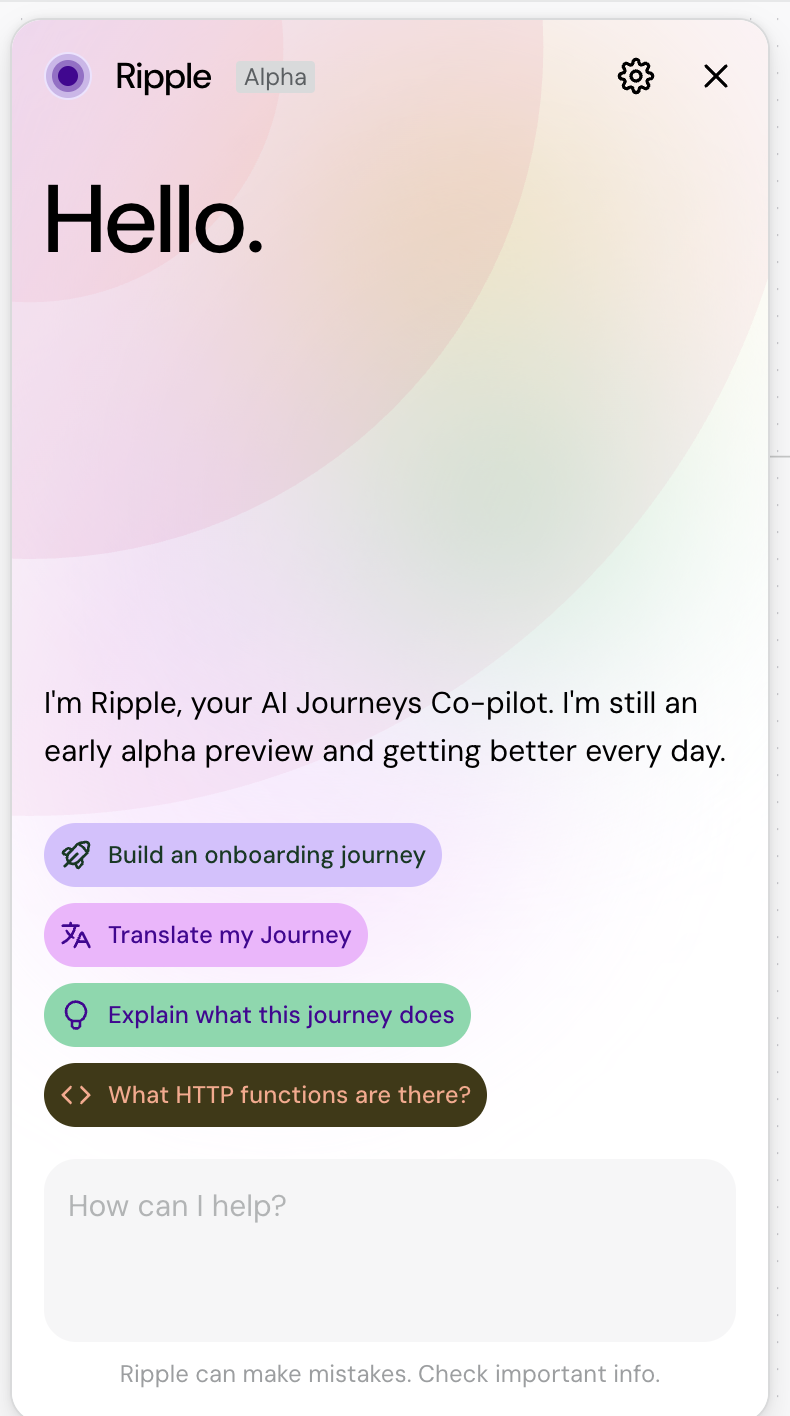
Ripple does more than build:
- Building — it builds entire, high-quality Journeys from a plain-language description.
- Automating — it handles routine work like translating your Journey into every language you support.
- Assist — it helps with the trickier technical steps, like validating an email address or making an API request.
- Answer — it answers questions about how Journeys and Turn.io work, so new team members aren't stuck.
The Agent card
The Agent card is the most powerful way to build with Turn.io today. Dropped into a Journey, it creates sophisticated, agentic AI conversations that feel natural and resilient. It brings together a set of configurable features:
- Instructions — define the agent's role, tone, and boundaries. For telehealth, that means being explicit about what it must never do (never diagnose, never prescribe) and when to hand off to a human.
- Actions — branching conditions that let the agent exit into the rest of your Journey without replying: escalate to a human the moment a patient asks, or route between specialised agents (a "router" pattern for multi-agent workflows).
- Memory — by default the agent sees the last two hours of conversation for context. You can set this to None, This journey, or the whole Conversation, with automatic compaction to keep token costs low.
- Pass profile fields — share as much or as little of the patient's profile as you choose (none by default, for privacy) so replies are personalised.
- Collect data — gather information proactively for onboarding, registration, appointment booking, or surveys, saving it straight to profile fields.
- Skills — background operations that enrich the conversation:
Knowledge Skills are optional pieces of information the agent retrieves only when needed, on the fly. Rather than stuffing everything into one enormous prompt — slow and expensive — you split knowledge into chunks.
Function Skills let agents act, not just answer — executing custom code to, for example, book an appointment or fetch a doctor's availability. They're built with the Lua programming language and the Turn SDK (and if you're not a developer, you can ask Ripple to generate them).
Both types of skill are reusable across agents — write once, use many times.
- Voice Agent can receive a voice note as input and reply with a voice note of its own. This lets your users choose how they prefer to engage — text or voice — and helps you have more impact in low-literacy regions.
To accept voice, select your Agent, scroll down, and enable Transcribe voice note.
Our voice capabilities have made a major leap forward. Turn.io now natively integrates four leading voice providers, which you install from the Apps page: ElevenLabs, Proto, Intron and Deepgram. These providers work everywhere voice matters in Turn.io: the Text-to-speech card and Speech-to-text card in Journeys, the Agent card (your Voice Agents), and Inbox voice note transcriptions.
Details
When AI is making decisions about a patient's care, you can't treat it as a black box. AI Logs capture every conversation your AI agents have — what the user said, how the AI responded, which model was used, how long it took, and what it cost. For Evals and Simulations, Turn.io integrates with Maxim to give you full visibility into every AI interaction in your Journeys.
Reminders
Reminders allow you to personalise and send the same pre-approved template to a selected group of people. Use them to send a massive communication or campaigns.
Our How to send a reminder? article explains it all and show you what to expect.
People
To provide better care and unlock the long-term relationships you want, you need to know your audience. The People page makes this a reality. Here you can:
- View everyone that have interacted with your service.
- Zoom in on the details of a single person and open the chat straight away.
- Import and/or update contact information from external services in Turn.
- Create and Use People Segments: create subsets of People and interact with these dynamic collections as needed. For example, you can set up segment so that you can send targeted messaging to mothers with high risk pregnancies due for an antenatal visit.
You can also Export Segments
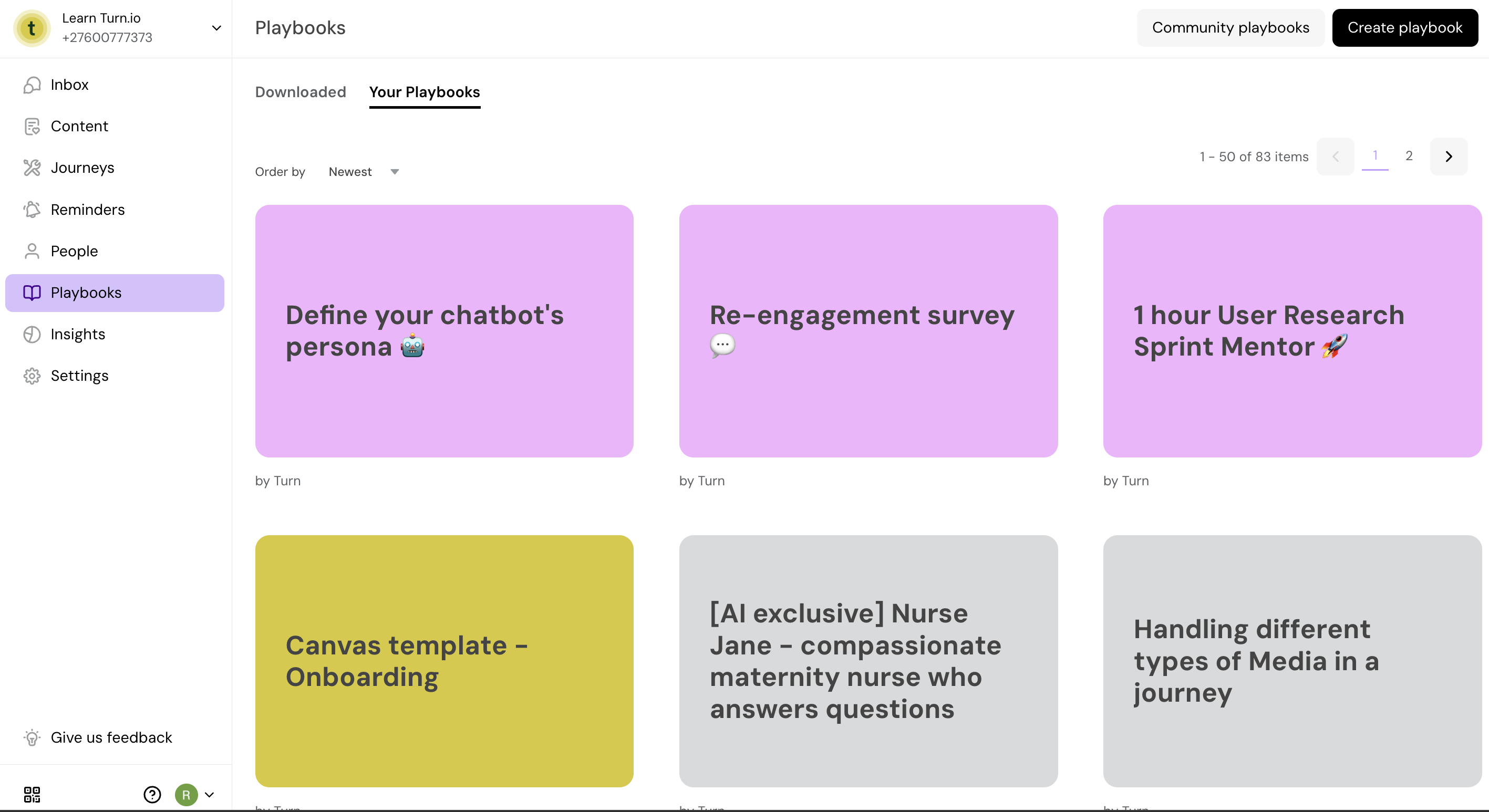
Playbooks
Playbooks are how we share best practice as a community, so we can accelerate our collective impact! Organisations share reusable components from the world's leading social-impact organisations.
Insights
Creating an impactful service works better when it's driven by data. Insights helps you understand interaction, users, and engagement patterns, focusing on four key questions to guide your users toward positive behaviour change:
- Are we making an impact?
- Is our audience growing?
- How are our users engaging?
- How are we guiding our users?
Settings
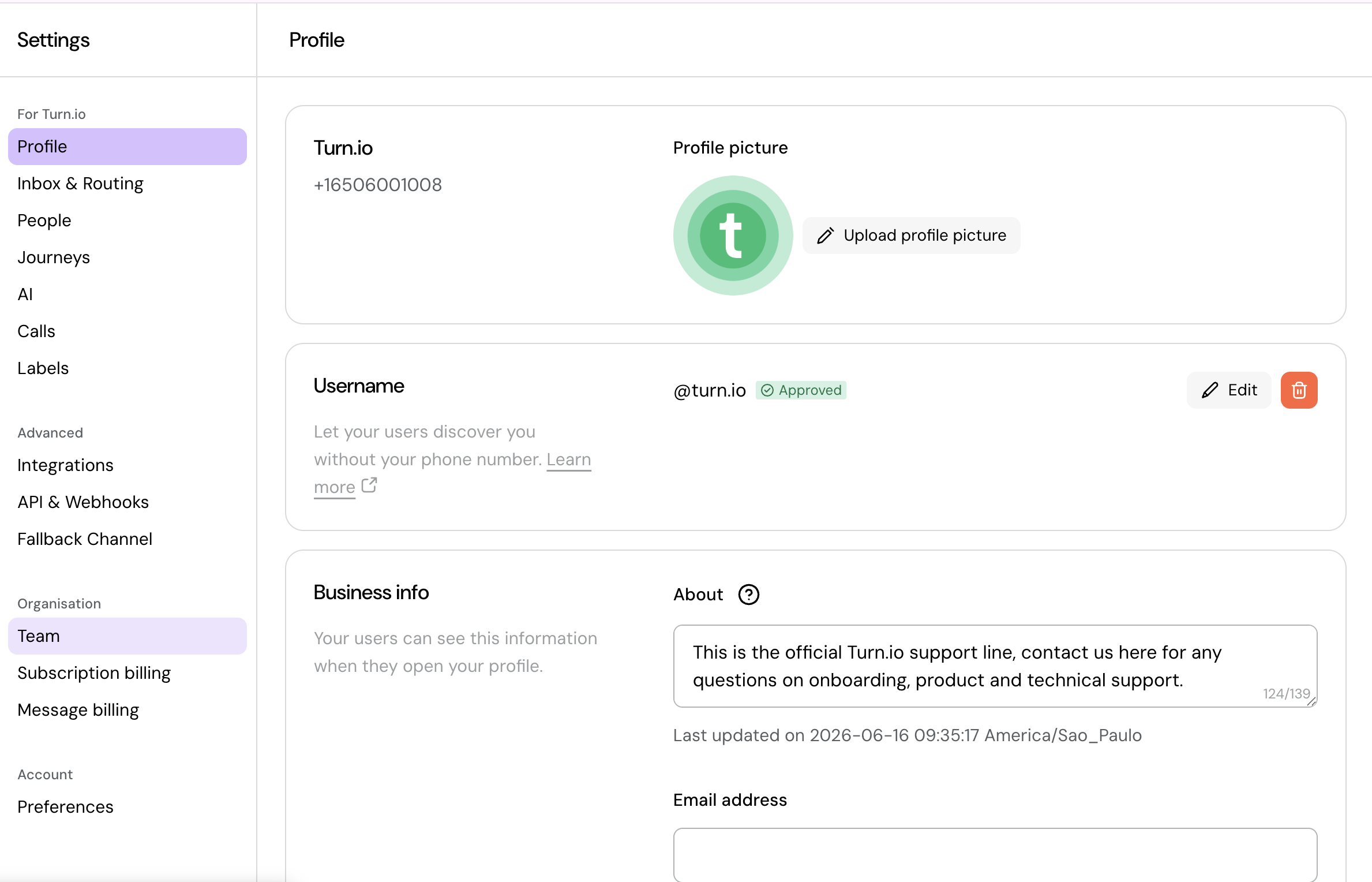
Mainly for your technical team, Settings lets you view and manage your WhatsApp profile information, Inbox and Routing, Custom fields, Journeys settings, AI settings, Calls settings, Labels, WhatsApp API status and rate limits, integrations and webhooks, fallback channel set-up, Turn API access tokens, add team members, Subscription and Message Billing information.
- View the amount your organisation has available to spend on conversations, with a breakdown of how it's calculated.
- View the breakdown of your spend (per day, number, and country) for the current and previous month, switching billing periods via a dropdown.
- Top up your available amount via self-service.
Profile Menu
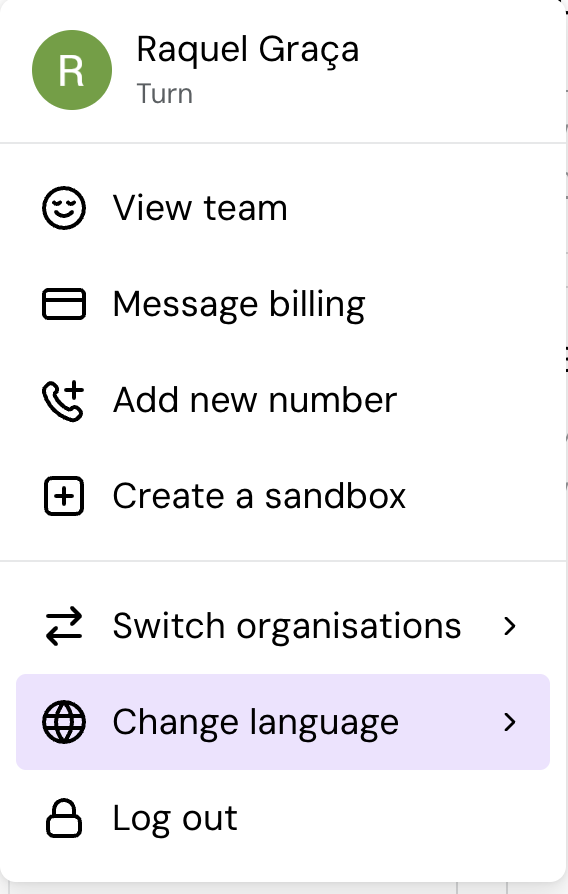
Besides logging out, the profile menu provides options to add a number and change the language. Currently, you can select between English and Portuguese.
Advanced features
Turn.io offers a large suite of advanced technical features, for teams who are technically sophisticated. Here's a summary:
- API: Turn.io offers multiple API's so that you can create extremely complicated and highly integrated systems, such as a messaging API, a contacts API, a Journeys API (that enables you to integrate external systems with Journeys) and much more. Find out more here.
- Apps: extend Turn.io with custom integrations, such as EMRs, CRMs, Payment gateways, and anything you need for your service to work. Find out more here.
- Advanced Journeys features: Journeys, although visual, are backed by code. You can extend beyond what the visual canvas offers by coding extremely complex and rich solutions. Find out more here.
You can find this, and much more in our developer documentation here.
Need help?
Take some time to explore each section, add your team members, and begin building. Then, go out there and make as much impact as you can!
If you need us, we’re here to help:
Available via WhatsApp or email support@turn.io.
Standard business hours: Monday to Friday, 9 AM to 5 PM local time (São Paulo GMT-3, Cape Town GMT+2, Islamabad GMT-5)